148972 stories
·
1 follower

Russia agreed to restart trilateral talks. Peace in Ukraine is far off.

1 Share

On the surface, President Donald Trump’s friend and envoy Steve Witkoff left Moscow on Wednesday with a handful of winning talking points: a U.S. citizen released and on his way home; Russia’s agreement to resume trilateral talks with Ukrainian representatives; and a Russian ship carrying diesel set to depart for the United States this week.

But in the tangled mess that is the war in Ukraine, all of those gestures benefit Russia most — leaving a ceasefire, let alone peace, a distant prospect for besieged Ukrainians, and the Trump administration and U.S. Republicans still grappling with high diesel and gasoline prices ahead of the midterm elections.

To win effusive praise from Witkoff and announce a resumption in negotiations, Russian President Vladimir Putin had to do very little: release Stephen Hubbard, a detainee of little value, and then overcome an obstacle of Russia’s own making: professed grievances over Ukraine’s stepped-up drone and missile strikes that coincided with Russia’s parliamentary elections in September.

Ukrainian President Volodymyr Zelensky did not disguise his dismay — or his cynicism about the diplomatic developments — as he used the latest Russian strikes on Kyiv to throw shade at Witkoff for praising Putin as a “humanitarian.”

“Three waves of ballistic strikes were launched by Russian ‘humanitarians’ against Kyiv from the evening,” Zelensky said. “They used 21 missiles. Unfortunately, there is a significant number of hits and damages in the city: ordinary houses, energy facilities, infrastructure of one of the stations and the metro, shopping centers, and enterprises. Among the damaged objects is even a monastery.”

“Twelve of our regions were under Russian strikes this night,” he continued. “In Kyiv and the regions, 34 people were injured, including five children. As of now, two deaths are known.”

Zelensky added: “Essentially immediately after the latest negotiations, Russia delivered a demonstrative strike. This means that there are no real changes in its attitude towards everything that is happening. It is important to continue trying to find the right solutions to end this war.”

As Kyiv and Moscow maneuvered for Washington’s favor Wednesday, Zelensky reiterated his willingness to freeze the fighting along current battle lines — a proposal that Trump had made just over a year ago and that Russia rejected, insisting that Ukraine surrender the entirety of its eastern Donetsk region, including the so-called “fortress” cities that Russia has tried and failed to capture for years.

Following Witkoff’s visit to St. Petersburg on Wednesday, high-ranking Kremlin aide Yuri Ushakov said the U.S. envoy’s points were so convincing that Moscow reconsidered its opposition to meeting a Ukrainian delegation and was willing to send delegates to Abu Dhabi in mid-November for technical talks, the first since February.

Ushakov said that Witkoff had informed Putin of the results of his talks with Zelensky in Oslo, adding there was little “substance” to the “new elements” of Ukrainian and European proposals. Ushakov said that he did not know how close the war was to ending but that “it is heading that way.”

Experts and analysts, especially in Ukraine, were less convinced.

“As experience shows, the mere fact that negotiations are taking place does not mean that a peace agreement is likely to be reached anytime soon,” Ukrainian political scientist Volodymyr Fesenko said in an interview. “It is more likely that the war will escalate at the same time, particularly the air war against Ukraine.”

“Russia’s attacks on Kyiv and Ukraine will be used as a tool to exert pressure on the negotiations,” he continued. “This is Putin’s preferred method. That is why I say that negotiations and an escalation of the war will take place simultaneously.”

Meanwhile, Oleksandr Merezhko, a Ukrainian member of parliament and chair of the committee on foreign policy and interparliamentary relations, described the talks as “a charade.”

“Russia is using the negotiations as a propaganda tool — that’s all — while we are trying to work with the Europeans and have some discussions and so on,” he said. “But there are no results anymore, and there won’t be any, unfortunately.”

Tatiana Stanovaya, a political scientist and fellow at the Carnegie Russia Eurasia Center, wrote on X that while Witkoff’s readout generated little enthusiasm in Moscow, recent sanctions relief and Trump’s latest shift toward Russia “have given Putin sufficient grounds to agree to resume negotiations, particularly as doing so comes at little cost to Moscow.”

“It is prepared to engage in discussions for tactical gains, calculating that these, combined with the further deterioration of the Ukrainian state, may eventually produce a strategic shift in Russia’s favour,” Stanovaya wrote.

Other Russian officials have called the latest meeting with Trump’s envoys a sign that “Washington shares the assessment” about the lack of substance in what Kyiv and its European backers have proposed.

Russia has long sought Trump’s support for a negotiated end to the war that would deliver victory to Putin by allowing him to seize all of Ukraine’s eastern Donbas region.

“The talks … are undoubtedly a prelude to a potential diplomatic breakthrough,” Russian lawmaker Leonid Slutsky said. “The latest meeting has, in effect, brought the issue of a settlement in Ukraine back onto the negotiating track.”

The talks are set to include military officers and Putin aide Vladimir Medinsky, a former culture minister now known for his revisionist history books about Ukraine. Putin, meanwhile, will head to China, where he is working to set up a joint meeting with Trump and Chinese President Xi Jinping on the sidelines of the Asia-Pacific Economic Cooperation summit.

That’s a format that the Russian leader has long seemed to prefer, in which he can push to end the war on his terms while bypassing Ukraine and Europe.

The idea of such a big-power summit has alarmed Ukrainian officials, with Foreign Minister Andrii Sybiha writing on X: “A trilateral ‌meeting between ⁠the leaders of Ukraine, the US, and Russia could help end the war sooner. A trilateral meeting between the leaders of Russia, China, and the US would do only the opposite: encourage Putin to continue this war.”

During his meeting with Putin, Witkoff hailed the diesel deal Trump struck with the Russian leader as “another example of what we can achieve by working together.”

The deal, which removes sanctions from Russia in a reversal of long-standing U.S. policy, is intended to lower fuel prices ahead of the midterm elections.

Putin has claimed that it lowered global diesel prices by 5 percent to 6 percent, a figure energy experts dispute. The amount of diesel Russia is releasing is marginal compared with overall U.S. usage and hardly enough to address the global energy crisis set off by the U.S. war with Iran.

Russian Deputy Prime Minister Alexander Novak said the first tanker with diesel bound for the U.S. was set to depart Thursday, even though the contract for the supplies has yet to be signed.

“This tanker will have a capacity of 40,000 tons,” Novak said. “And, certainly, further shipments will follow.”

To ship diesel to the U.S., Russia had to lift its own export embargo, imposed after systematic Ukrainian drone strikes knocked out some of the country’s largest oil refineries, creating shortages and price spikes for Russians.

Those strikes forced Russia to prioritize its domestic market, ration fuel at home and even temporarily permit the sale of lower-grade fuels to stabilize domestic availability.

Novak hinted that production limits were still in place and that the destination for diesel shipments will depend on “what volumes we can supply — over and above the needs of the United States.”

Details aside, the deal has given Putin a basis to push one of his mainstay talking points: that the West is hurting itself by imposing economic sanctions on Russia and ultimately won’t be able to meet its own needs without resuming purchases of Russian fossil fuels.

For Putin, who is also aware that Trump may flip positions again after the midterm elections, the current thaw with Washington creates an opportunity to improve ties with the U.S. while pushing ahead with a plan to make winter the most miserable yet for Ukraine in the nearly five-year-long invasion.

The Kremlin seems to hope that will break Ukraine’s resolve and European support for Kyiv will collapse.

But for Russia, there is also a risk of overplaying its hand, said Vladimir Pastukhov, a Russian political scientist.

“The Putin regime will never have a more favorable opportunity to extricate itself from this war than it does right now,” Pastukhov said. “The frantic, restless way Putin is acting suggests he may, in part, grasp this. But hubris — the eternal nemesis of Russian emperors — stands in the way.”

Pastukhov said Trump appears to have moved away from a belief that freezing the fighting would be the best way to end the war quickly and is instead mulling a solution “in the manner of a gangland showdown.”

“In any case, I believe that this is no ordinary moment in the history of this war … but a true point of no return, a juncture where an intense struggle is underway over the terms of peace,” Pastukhov said.

“In all likelihood, this round of ping-pong will prove inconclusive; what happens next will depend on whether Trump is capable of moving from hints to action — that is, whether he will risk openly siding with Putin in this war, thereby forcing Europe — and, along with it, Zelensky — to capitulate.”

In Ukraine, trust in U.S. support has already evaporated.

After Trump cut off direct military and financial aid, the three key remaining areas of U.S. assistance — intelligence sharing, Starlink satellite internet service and arms sales — each proved vulnerable during the past week, as the White House seemed to pressure Kyiv.

Fesenko, the political scientist, cited “a crisis in bilateral relations.”

“This is evidenced by Trump’s very harsh, sometimes aggressive statements, including calls for a change of president in Ukraine,” he said. “The risks have therefore become apparent precisely in the remaining areas of cooperation.”

On Thursday, Ukrainian commanders were still reporting issues with Starshield, the military equivalent of Starlink, despite assertions by the Trump administration that service had been restored.

“Starshield continues to operate across all sectors of the front line, but with a speed limit of 160 km/h. This has created certain problems for us,” Andriy “Klima” Klymenko, commander of the 414th Unmanned Systems Brigade “Birds of Magyar,” told The Washington Post.

“The worst part is that nobody warned us that the restrictions were being introduced,” Klymenko said. “We found out about them in the middle of combat missions, when we started losing aircraft.”

“We have now adapted, but the problem has not gone away,” he added. “At lower speeds, our drones become easier targets for the enemy. This directly undermines the effectiveness of operations.”

Natalia Abbakumova contributed to this report.

Read the whole story
Michael_Novakhov
6 hours ago
reply
http://michael_novakhov.newsblur.com/
Share this story
Delete

At what stage is a counterintelligence investigation considered to be solved?

1 Share

AI Mode reply for At what stage is a counterintelligence investigation considered to be solved?

A counterintelligence (CI) investigation is rarely "solved" in the traditional sense of a closed criminal case. Instead, it reaches a depending on the strategic goal of the operation.

Unlike standard law enforcement investigations that focus strictly on an arrest and trial, counterintelligence involves long-term management of national security threats.

Key Stages Where a CI Investigation Concludes or Resolves

  • Neutralization: The threat is neutralized when the hostile foreign intelligence operative, insider, or spy is identified, apprehended, or cut off from access to sensitive/classified information.
  • Conversion to a Double-Agent or Deception Operation: Rather than arresting a suspect immediately, the investigation may "turn" the operative into a double agent. The case changes from a pure probe into a managed offensive operation to feed the foreign service false information.
  • Prosecution and Trial Stage: If the government chooses to pursue criminal charges (such as espionage, treason, or export control violations), the investigative phase transitions into a legal case, culminating in indictment, plea bargaining, or a trial.
  • Formal Written Declination: If the Department of Justice declines prosecution—often because bringing the evidence to open court would compromise classified sources, methods, or wiretaps—the FBI or military counterintelligence component receives a formal written declination. At that point, the agency pivots to administrative actions (such as revoking security clearances, firing, or reassigning personnel) or defensive/mitigation measures.
  • Administrative Closure or Suspension: An investigation is officially closed or suspended when all leads are exhausted, the vulnerability is patched, or authority (such as a Military Department Secretary or agency head) approves termination. Closed CI files can also be reopened later if new digital, human, or technical intelligence emerges.

If you are looking at a specific agency (like the FBI, Army Counterintelligence, or the Diplomatic Security Service) or a particular type of threat (like cyber espionage or insider threats), let me know and I can detail their exact administrative closure process.

  • Executive Services Directorate (.mil)

    DoDI 5240.04, "Counterintelligence (CI) Investigations," April ...

    Apr 1, 2016 — If the objection cannot be resolved at a local level, the objection will be addressed through the appropriate Military Department ...

  • U.S. Department of State (.gov)

    Counterintelligence Investigations - State Department

    The Diplomatic Security Service (DSS) runs a robust counterintelligence program designed to deter, detect, and neutralize the effo...

  • Counterintelligence Investigation: Legal Insights Explained | US Legal Forms

    Definition: Process examining and gathering evidence for legal action against individuals or groups suspected of espionage, sabota...

  • YouTube·The Institute of World Politics

    Myths vs Reality in U.S. Counterintelligence

    Mar 5, 2026 — Inside Counterintelligence: Myths vs Reality in U.S. Counterintelligence and 1978. so this becomes the crux of a not a problem but...

  • American Civil Liberties Union

    A Brief Summary of the FBI's Counterintelligence Program

    Page 6 What is the FBI's legal authority to conduct counterintelligence investigations and operations? ■ FBI Jurisdiction • Invest...

  • U.S. Department of State (.gov)

    Counterintelligence Investigations

    Counterintelligence Investigations All counterespionage investigations are conducted in close coordination with the FBI in accorda...

  • American Military University

    What Is Counterintelligence? Understanding Its Role

    It also includes policies for handling classified information, such as controlling access to sensitive material, securing storage ...

  • Federation of American Scientists

    FM34-60 COUNTERINTELLIGENCE - Chapter 2 INVESTIGATIONS

    Authority: EO 12333 and AR 381-20 govern US Army intelligence and counterintelligence (CI). Investigations: Divided into CI invest...

Copied to clipboardFailed to copy to clipboard. Try again later.

Read the whole story
Michael_Novakhov
6 days ago
reply
http://michael_novakhov.newsblur.com/
Share this story
Delete

9/11 attacks investigations: approaches and hypotheses

1 Share

AI Mode Conversation: 9/11 attacks investigations: approaches and hypotheses

9/11 attacks investigations: approaches and hypotheses

AI Mode reply for 9/11 attacks investigations: approaches and hypotheses

Investigations into the September 11, 2001, terrorist attacks have relied on distinct official, academic, and alternative investigative approaches, evaluating several core hypotheses regarding who was responsible, how the security breakdown occurred, and whether the hijackers received external state support.

1. Official Government and Forensic Investigations

The primary official approach relied on bipartisan congressional mandates, criminal forensics, and specialized engineering analyses to establish the definitive timeline and mechanism of the attacks.

  • The 9/11 Commission Approach: Established by Congress and President George W. Bush in late 2002, the National Commission on Terrorist Attacks Upon the United States focused on intelligence integration, homeland defense, and institutional preparedness. Its approach relied on reviewing sensitive intelligence, interviewing hundreds of witnesses, and examining counterterrorism policies across federal agencies.
  • The FBI's PENTTBOM Investigation: The FBI launched its largest-ever historical inquiry, codenamed PENTTBOM. Operating out of FBI Headquarters, thousands of agents tracked global leads to quickly identify the 19 hijackers and trace their financial transactions and logistical footprints.
  • The NIST Structural Forensic Approach: The National Institute of Standards and Technology (NIST) conducted an engineering-focused investigation. Their approach relied on structural models, physics simulations, and recovered debris to examine how the kinetic impact of the aircraft and subsequent jet-fuel fires compromised the infrastructure, ultimately attributing the collapse of the Twin Towers and 7 World Trade Center to these fires and impacts.

2. Hypotheses Evaluated by Investigators

Investigators tested several major hypotheses concerning the execution and support network of the plot.

  • The Al-Qaeda Operational Hypothesis (Confirmed Consensus): The core hypothesis validated by the 9/11 Commission Report and international intelligence is that 19 operatives from the Salafi-Jihadi group al-Qaeda, directed by Osama bin Laden, carried out a coordinated suicide plot. This hypothesis was corroborated by extensive financial trails, communication logs, and martyrdom videos.
  • The Systemic Intelligence Failure Hypothesis: This approach explored why the U.S. intelligence community failed to disrupt the plot. Investigations exposed massive institutional deficits, including an inadequate analytical pool, a lack of clear threat dissemination guidance, and poor information-sharing between the CIA and FBI regarding operatives already inside the U.S..
  • The External Support and Foreign Government Liaison Hypothesis: A long-running area of active investigation concerns whether the hijackers had an active support network inside the United States, specifically examining links to foreign state nationals. For instance, civil lawsuits brought by 9/11 families have scrutinized individuals like Saudi national Omar Albayumi, who assisted two hijackers with housing and bank accounts. While early commission findings downplayed his involvement, subsequent disclosures—including pre-operational video surveillance of the U.S. Capitol and pilot descent formulas seized from an associate's apartment—have kept open the hypothesis that the hijackers relied on local facilitators.

3. Alternative and Non-Consensus Hypotheses

A disparate community known as the 9/11 Truth Movement rejects the official findings, proposing alternate hypotheses that have been uniformly dismissed by the scientific and investigative consensus.

  • LIHOP (Let It Happen On Purpose): This hypothesis claims that elements within the United States government possessed specific, actionable advance intelligence about the attacks but intentionally permitted them to happen to justify geopolitical military expansion.
  • MIHOP (Made It Happen On Purpose): This hypothesis posits that the attacks were a "false flag" operation actively planned and orchestrated by inside elements within the U.S. security apparatus.
  • Controlled Demolition Theory: Adherents to this theory argue that the structural damage from plane impacts and fires was insufficient to cause the symmetrical collapse of the buildings, claiming instead that explosives or incendiaries were pre-planted in the World Trade Center towers. Peer-reviewed structural engineering bodies and NIST heavily documented the physical progression of the thermal-structural collapses to refute this.

Copied to clipboardFailed to copy to clipboard. Try again later.

  • 9/11 Investigation - FBI.gov

    The PENTTBOM Team coordinated the investigation out of a basement office, where dozens of agents would build a case against those ...

  • 9/11 conspiracy theories - Wikipedia

    LIHOP (let it happen on purpose) or. Core Theories: Controlled demolitions of WTC towers and building 7; a missile strike or no-pl...

  • 9/11 Truth movement

    The 9/11 truth movement encompasses a disparate group of adherents to a set of overlapping conspiracy theories that dispute the ge...

  • National Commission on Terrorist Attacks (.gov)

    National Commission on Terrorist Attacks Upon the United States

    the United States (9-11 Commission) created late 2002 by Congress and President George W. Bush to account for the September 11, 20...

  • September 11 Attacks: Facts, Background & Impact

    19 terrorists from the Islamic extremist group al Qaeda—founded by Osama bin Laden—hijacked four commercial passenger airplanes an...

  • Department of Justice Office of the Inspector General (.gov)

    Special Report: A Review of the FBI's Handling of Intelligence Information Related to the September 11 Attacks (Full Report)

    Deficiencies: Inadequate analytical program, limited FISA use, poor interagency/internal information dissemination, lack of threat...

  • Recently surfaced 9/11 evidence includes video of Capitol ...

    Apr 28, 2025 — Despite the 9/11 Commission concluding Albei was an "unlikely candidate" for involvement, new evidence and expert analysis suggest...

  • Facebook·The Times and The Sunday Times

    What mysteries of 9/11 remain unsolved? A quarter of a century ...

    Sep 11, 2026 — Albayumi, who helped the hijackers secure an apartment and bank account, claimed a chance meeting but possessed a sketch of a plan...

Read the whole story
Michael_Novakhov
9 days ago
reply
http://michael_novakhov.newsblur.com/
Share this story
Delete

EXCLUSIVE | Leaked emails reveal former German intelligence chief's Mossad links

1 Share

Former German intelligence chief August Hanning is accused of treason and spying for a foreign agency after allegedly obtaining about 2,000 classified BND documents and using them in dealings with intelligence officials from an unnamed foreign country.

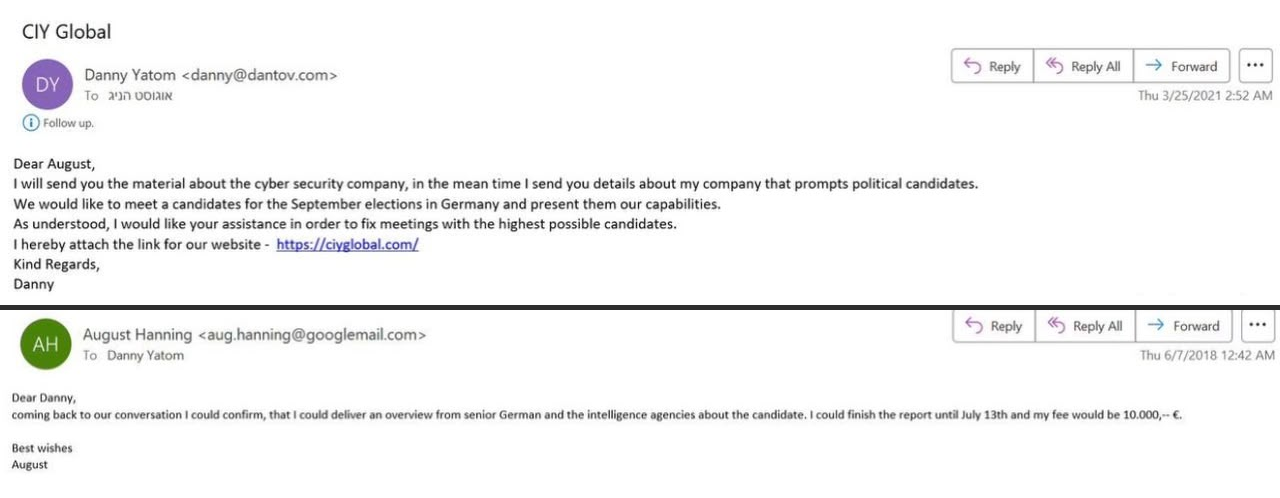
Berlin has not publicly named the recipient, but emails obtained by The Cradle reveal a relationship between Hanning and former Mossad director Danny Yatom.

August Hanning headed the BND from 1998 to 2005. He was arrested on 6 October on suspicion of espionage-related offenses. 

Prosecutors allege that Hanning obtained sensitive documents from Manfred D., a former BND employee. The documents reportedly included internal briefings prepared for senior German officials. 

The case has revealed how vulnerable Germany’s intelligence apparatus is to people who exploit their official positions and personal networks for private gain.

Emails between Hanning and Yatom provide a glimpse into those networks

In 2018, Hanning told Yatom he could provide “an overview from senior German and the intelligence agencies about the candidate.” He offered to complete the report by 13 July for €10,000. 

The email does not name the candidate, but the exchange sheds light on the nature of the relationship.

Three years later, Yatom approached Hanning about arranging meetings with senior candidates in Germany’s September 2021 federal election. 

The former Mossad chief wanted to show the candidates what his “political-campaign company”, CIY Global, could do. In the same email, he mentioned material he planned to send about a cybersecurity firm.

Although the emails concern separate matters, together they reveal the relationship: Hanning offered access to German intelligence and political circles, while Yatom built businesses around political influence and cybersecurity.

These were not two former officials who had simply gone their separate ways after leaving public service. Their correspondence reveals an ongoing relationship where intelligence contacts and commercial ambitions intersected.

Their business ties extended beyond political campaigning. Yatom was linked to World Health Energy Holdings, a cybersecurity company where Hanning reportedly served on the advisory side. 

The shadow network connected a former BND chief and a Mossad director through businesses where access to sensitive information and political decision-makers can be highly lucrative.

Israel has built a global market for surveillance, cyber-intelligence and political influence, partly staffed by intelligence veterans. These firms give capabilities developed in intelligence commercial cover and international reach.

Across Europe, impacts are evident. On 12 October, Polish prosecutors said data collected by the Pegasus spyware had been sent abroad and that Israel's NSO Group retained technical access to parts of the system. 

Under Poland’s previous government, Pegasus targeted political opponents and others, exposing the risks of letting an Israeli company access infrastructure used to collect highly sensitive political and personal data.

In Spain, the 2022 CatalanGate investigation documented at least 65 people connected to Catalan politics and civil society who were targeted or infected with Pegasus or Candiru spyware. 

Those affected included politicians, lawyers, and civil society figures. Researchers at the University of Toronto’s Citizen Lab found strong circumstantial evidence linking the campaign to Spanish authorities.

Greece’s surveillance scandal involved targeting journalist Thanasis Koukakis and European Parliament member Nikos Androulakis, along with the use of Predator spyware linked to Intellexa, a company founded by former Israeli intelligence operative Tal Dilian. 

Across these cases, surveillance tools from Israeli-linked firms targeted people whose work and politics challenged those in power.

Israel has established itself as one of the world’s leading exporters of technologies for penetrating phones, monitoring political opponents and obtaining information that would otherwise remain private, while former intelligence personnel have turned their experience into profitable international businesses.

The Hanning affair raises the possibility that this same world of intelligence veterans, private ventures, and political access also played a role in handling Germany’s state secrets. 

The 2018 email shows Hanning offering intelligence-related reporting to Yatom for a fee. 

The 2021 email shows Yatom seeking Hanning’s help reaching senior German political candidates. 

Their cybersecurity business ties add another layer to the relationship. These facts do not establish where the documents at the centre of the espionage case ultimately went, but they give German investigators a concrete reason to examine whether interests linked to Israeli intelligence were involved.

Read the whole story
Michael_Novakhov
9 days ago
reply
http://michael_novakhov.newsblur.com/
Share this story
Delete

Hamburg Cell operated successfully through strict operational security

1 Share

Hamburg Cell operated successfully through strict operational security

AI Mode reply for Hamburg Cell operated successfully through strict operational security

The Hamburg Cell , allowing them to evade intelligence detection while planning the September 11 attacks. Rather than operating completely in the shadows, they exploited gaps in international law enforcement by maintaining an unremarkable, highly integrated profile in daily German life.

Methods of Operational Control

  • The "Dual-Life" Strategy: The core members—including Mohamed Atta, Marwan al-Shehhi, and Ziad Jarrah—enrolled as engineering and aeronautical students at German universities. They maintained a normal civilian presence, dressed in Western clothing, and interacted naturally with professors and peers to mask their radicalization.
  • Decentralized Logistics: To hide their travels to terrorist training camps in Afghanistan, supporting cell members like Said Bahaji handled their apartments, mail, and university registration. This logistical buffer ensured that core pilots could leave Germany for months at a time without triggering official absences or drawing suspicion.
  • Compartmentalized Communication: The cell largely avoided electronic communications for highly sensitive matters, relying on face-to-face meetings at their shared apartment on Marienstrasse in Hamburg. When digital tools were required, they used shared public terminals or single laptops to execute research, keeping their network narrow.
  • Exploitation of Financial and Legal Gaps: The group capitalized on decentralized international financial structures. They funded flight training and safe houses through legitimate-looking international wire transfers, navigating legal gray areas before the implementation of post-9/11 counterterrorism financial tracking.

German federal investigators and global intelligence agencies only fully uncovered the depth of the Hamburg Cell after the hijackings occurred, leading to an extensive overhaul of European immigration, data mining, and surveillance laws.

Copied to clipboardFailed to copy to clipboard. Try again later.

  • Hamburg cell - Wikipedia

    was a network of Islamist extremist activists based in Hamburg, Germany, pursue higher education in engineering or related fields.

  • Germany's connection to the 9/11 attacks

    Germany passed strict anti-terrorism laws, expanded intelligence and police powers, enabled data-mining searches, and tightened im...

  • Transcript | Inside The Terror Network | FRONTLINE | PBS

    The September 11 attacks were planned and executed by a Hamburg-based Al Qaeda cell led by Mohamed Atta, alongside Marwan al-Shehh...

  • Hamburg cell reveals details - September 18, 2001

    The three suspects known to investigators are Ziad Jarrah, Marwan al-Shehhi and Mohammed Atta. Only after the three men perished i...

  • British Council UK Films Database

    The Hamburg Cell

    The Hamburg Cell is a devastatingly powerful work that puts faces and personalities to the men who carried out the attacks against...

  • The 9/11 hijackers : inside the Hamburg cell | <a href="http://WorldCat.org" rel="nofollow">WorldCat.org</a>

    The group, now collectively known as the Hamburg Cell, was ultimately found responsible for the cultivation of the al-Qaeda plot c...

  • More ties between al Qaeda plotter and 9/11 Hamburg cell ...

    Bahaji and another member of the Hamburg cell, Mounir el Motassadeq, assisted the “core Hamburg cell members” by handling “their a...

  • Alleged 9/11 Mastermind Linked to Hamburg Cell

    Jun 6, 2002 — Khalid Shaikh Mohammed, who authorities now believe conceived the Sept. 11 attacks, apparently met with the terrorist plot's chief...

Read the whole story
Michael_Novakhov
9 days ago
reply
http://michael_novakhov.newsblur.com/
Share this story
Delete

How 9/11 helped Israel sell its war on Palestinians to America

1 Share

For me, the New York City skyline was close to home. Quite literally. I grew up just across the Hudson River, with the famed skyline of America’s biggest city visible from my bedroom window. Being a Palestinian American living just outside of the world’s most famous city meant that I spent part of my summers as a tour guide for family visiting us from the Middle East, who, like so many people around the world, wanted to see the Big Apple that the movies and live broadcasts from Times Square on New Year’s Eve had made so famous.

I took visitors to the Statue of Liberty, the Empire State Building, Central Park and the World Trade Center. My last tour was in the final days of August 2001. We went to the observation deck of the World Trade Center known as “Top of the World”. Little did I know that two weeks later that deck, where we had stood looking out at the amazing metropolis below, would come crashing down along with the entire World Trade Center, killing thousands and instantly changing the world as we had known it.

By the time of the September 11 attacks, I was back in my dormitory at university in New England and huddled around a 10-inch television screen with floormates watching ABC’s Peter Jennings cover the horrific news as it was unfolding that Tuesday morning. Among the early reactions was one from Benjamin Netanyahu, then a former prime minister of Israel. Asked by The New York Times what the attack meant for relations between the United States and Israel, Netanyahu replied, “It’s very good.” Then he edited himself: “Well, not very good, but it will generate immediate sympathy,” adding that the attack would “strengthen the bond between our two peoples”. This was his response while ground zero was still smouldering after an attack that had killed nearly 3,000 people.

It immediately hit me that not only was the world about to change, but my life in the US as a Palestinian American was about to become far, far more complicated. The US was about to embark on military engagement in the Middle East, and Netanyahu was excited by the opportunity this presented Israel.

To better understand the impact this moment had on US-Israel relations, it is crucial to consider the preceding context. I have argued elsewhere that the period between the end of the Cold War and 9/11 was a complicated one for US-Israel relations. For most of the history of the US-Israel relationship, the Cold War was the defining paradigm in international relations. For Israel, this was an easy paradigm to navigate. It billed itself to Americans as a like-minded, US-aligned democracy confronting Soviet-backed satellite states in the Arab world.

But as the Cold War ended, the political landscape shifted. The Berlin Wall fell, democratisation swept Eastern Europe, and apartheid ended in South Africa, while Israel was brutally repressing the first Palestinian Intifada. Suddenly, Israel did not fit so comfortably in this new world order. It was during this period that the US made its greatest investments in Israeli-Palestinian peacemaking, however flawed, and used some leverage to press the Israeli government on settlement building.

September 11 and the ensuing global “war on terror” changed all of this. With the second Palestinian Intifada under way, the September 11 attacks on the US provided an opportunity to once again put Israel and the US on the same side of a new defining global divide. Instead of communism, the new global bad guy was radical Islam.

Netanyahu and his allies understood this very well, just as he made clear to The New York Times 25 years ago this week. A wounded America was primed for Islamophobic narratives, and pro-Israel voices were often happy to provide them, as they understood that an America obsessed with “counterterrorism” would have to stay close to Israel.

There are numerous areas where we see the impact of this over time: enhanced US-Israel intelligence collaboration, growing US financial support for Israel and legislative initiatives supported by Israel’s backers in the US that used broadened anti-terror authorities to crack down on Palestinians, to name a few.

The narratives that helped support these outcomes also went beyond simply linking Israel and the US through a common “terrorist threat”. Palestinians were also more easily turned into a “security problem” to American audiences. Instead of asking why Palestinians were resisting oppression, American audiences were pushed to see Israeli repression as self-defence similar to US behaviour. Muslims were often cast as one of two types in American discourse: moderate or extremist, and those criticising Israel were routinely placed in the latter category, which led to stigma and a chilling effect.

Israeli military practices could be cast as useful for America as well. Surveillance, counterinsurgency, targeted killings and other tactics Israel had used in the West Bank and Gaza, which had occasionally been criticised by Washington, were used by American forces in Iraq and Afghanistan and thus increasingly legitimised before American audiences.

Some of the greatest purveyors of the Islamophobic narratives that characterised much of the post-9/11 period in the United States included David Horowitz, who consistently sought to connect Palestinians with terrorism and called for profiling to make Palestinian identity itself a security concern; Daniel Pipes, who often characterised Muslim organisations as potentially or secretly militant, casting suspicion on Muslim advocacy; Steven Emerson, who sought to popularise infiltration narratives to try to turn mainstream Muslim organisations into security subjects; Brigitte Gabriel, who regularly framed Islamism as a civilisational threat, thus casting Israel as a front-line defender of the West; and David Yerushalmi, who sought to expand the threat narrative to Sharia law and Muslim political influence, thus casting Muslim political participation as potentially subversive.

The general logic of these narratives was that terrorism was effectively synonymous with all things Palestinian/Arab/Muslim and thus Israel’s security model should be seen as legitimate, if not ideal, by Americans.

It is important 25 years later to reflect on the dangerous political opportunism that spewed hate into American discourse to cast Israel and Israeli policy in a favourable light. A quarter-century later, the US is once again embroiled in a seemingly intractable quagmire, this time in Iran, a losing effort that has already cost Americans more than $100bn through higher petrol and diesel prices. Given all of this, Americans today should be quick to question Islamophobic narratives, the dangerous paths they lead down and the real motives of those who spread them.

The views expressed in this article are the author’s own and do not necessarily reflect Al Jazeera’s editorial stance.

Read the whole story
Michael_Novakhov
11 days ago
reply
http://michael_novakhov.newsblur.com/
Share this story
Delete
Next Page of Stories